


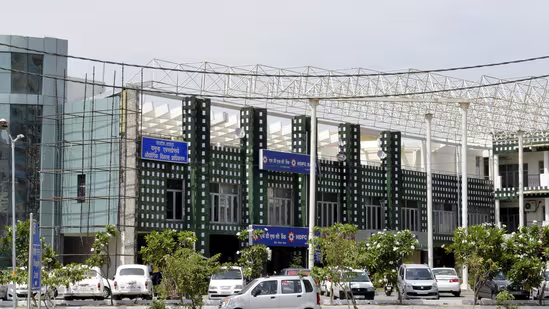
The Uttar Pradesh government has officially approved Phase 2 of the Yamuna Expressway Industrial Development Authority (YEIDA) “Master Plan 2031,” opening the door for large-scale urban, industrial, and infrastructure development across key districts along the 165-kilometre Yamuna Expressway corridor.
What’s Covered in Phase-2
-
Phase-2 spans approximately 2,593 square kilometres, covering portions of Mathura, Agra, Aligarh, and Hathras.
-
Combined with Phase-1, which covers about 759 sq km in Gautam Buddha Nagar and Bulandshahr, the total area under YEIDA’s jurisdiction now reaches 3,352 sq km, encompassing around 1,149 villages.
Key Urban Centres & Major Projects
Under the new master plan, several major urban centres and development projects are planned:
-
Raya Urban Centre (Mathura): This hub, already identified earlier, is being expanded — its area was increased from 9,366 hectares to 11,653 hectares in late 2024. A centerpiece project here is the proposed Heritage City, covering around 753 hectares with an estimated cost of ₹7,200 crore. Under the plan, YEIDA will provide the land while a private developer (concessionaire) will handle construction and development under a 70-year concession.
-
Tappal-Bajna Urban Centre (Aligarh): Close to the upcoming Noida International Airport (Jewar), this area is slated for a modern Logistics Park — a sprawling 364-acre facility expected to bolster industrial growth, warehousing, and supply-chain infrastructure to meet rising demand in the NCR region.
-
Proposed Urban Centres: Agra & Hathras — YEIDA also intends to develop a New Agra Urban Centre, envisaged to host commercial, tourism-oriented, and recreational zones while complying with environmental regulations, especially given the proximity to heritage and protected areas. Meanwhile, for Hathras district, plans are underway to appoint consultants to prepare a detailed project report (DPR) for an upcoming urban centre.
Why the Timing Matters
The approval comes at a strategic moment. With the Noida International Airport at Jewar expected to become operational soon (originally projected around April 2025), these developments are likely to see accelerated momentum. Authorities believe the new airport, along with improved infrastructure and urban planning, will act as a major catalyst for economic growth, real estate demand, industrial expansion, and overall urbanization along the Yamuna Expressway corridor
The move also ends more than a decade of uncertainty — the Phase-2 proposal was initially introduced in 2012–13, but execution was delayed for years before final approval in 2025.
What It Means for Residents, Investors & the Region
-
For Homebuyers & Real Estate Investors: The plan promises new residential zones, improved connectivity, and infrastructural clarity. Regions around Mathura, Aligarh, Hathras, and Agra may see increased demand for housing and commercial properties.
-
For Industries & Businesses: Logistics hubs like the Tappal-Bajna Logistics Park and new urban centres offer opportunities for warehousing, manufacturing, supply‐chain operations, and ancillary services.
-
For Economy & Employment: The development is expected to generate significant employment opportunities — in construction, industrial operations, services, tourism, retail, and more — potentially transforming once rural/village-heavy areas into bustling urban zones.
-
For Regional Growth & Connectivity: Better urban planning, mixed land use (residential + commercial + industrial), and proximity to Noida, Jewar Airport, and expressway infrastructure could make these areas attractive not only for locals but also for people relocating from congested metros.